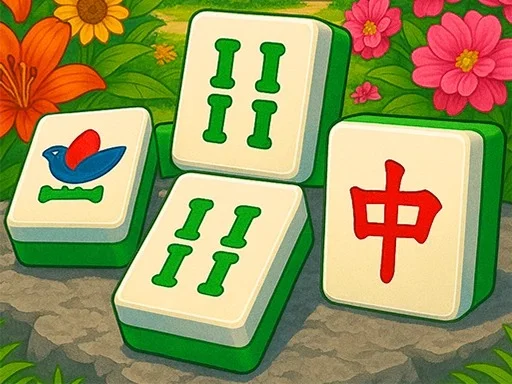
Mahjong Garden
New Games



Rating:
4.31
Played:
11,492
Mahjong Garden and the Appeal of Calm Tile Clearing
Mahjong Garden is a browser mahjong solitaire puzzle where you match free tiles, open layered layouts, and work toward a full board clear one pair at a time. It feels approachable in the first minute because the controls are simple, but the puzzle quickly becomes more thoughtful than it first appears. Every move changes which tiles stay trapped, which edges open up, and how easy the final stretch of the board will be.
That balance is what gives Mahjong Garden its staying power. You are not learning the rules of traditional four player mahjong. Instead, you are solving a solo tile puzzle built around visibility, sequencing, and patience. The garden themed presentation keeps the mood soft, yet the decisions still matter. A pair that looks harmless now can make later moves much easier or much harder.
What You Are Really Doing on Each Board
The goal in Mahjong Garden is to remove matching tiles until the board is empty. The important part is that not every visible tile is playable. In this style of mahjong solitaire, a tile is usually considered free only when no other tile is resting on top of it and at least one long side is open. That single rule turns a relaxing matching game into a layered logic puzzle.
Because of that, good play is about more than spotting identical symbols. You are also asking which pair will reveal something useful. One move might only shrink the board a little. Another might free the top of a stack, open an outer lane, or expose a buried tile family that had no options a moment ago. Mahjong Garden rewards the second kind of move far more often.
Why move order matters
Many layouts begin with plenty of visible choices, which can make the game look easier than it really is. The real challenge appears when several legal pairs compete for your attention. If you remove the wrong pair too early, its matching copies may stay buried under later layers. If you choose a pair that opens space, the board often becomes easier to read and finish. That is why experienced players pause before clicking instead of rushing through the first matches they notice.
Playing Mahjong Garden in Your Browser
Browser play is a natural fit for Mahjong Garden because the puzzle does not need a long setup or a complicated tutorial. Open the page, let the board load, and start scanning the layout. On desktop, the larger view makes it easier to compare distant parts of the board and notice which lanes are still open. On phones and tablets, touch controls keep the experience direct, especially if you rotate the screen to give the tile field more room.
The controls are intentionally light. Click or tap one free tile, then select its matching partner. If both are legally available, the pair disappears at once. If nothing happens, one of the tiles is probably still blocked or the faces do not belong to the same matching set. Because the input is so simple, improvement comes from reading the board better, not from faster hands.
Helpful features you may see
Public browser listings for games in this category commonly mention support tools such as hints or recovery options when a round gets tight. If your current build includes them, use them as guidance rather than as your whole strategy. A hint is most useful after you have already scanned the board yourself. That way, it teaches you where your eyes missed a pattern instead of replacing the pattern reading entirely.
Habits That Make Boards Easier to Finish
Start with top layers and outer edges
A dependable first habit is to look at the highest exposed tiles and the far left and right edges before making early matches. Those positions control access to deeper parts of the layout. When you free the top of a stack or open an edge lane, several future moves often become available at once.
Do not treat every open pair as equal
New players often assume that any legal match is a good match. In practice, some pairs are much more valuable than others. If one pair only removes clutter while another reveals a hidden row beneath it, the revealing move usually has more long term value. Mahjong Garden becomes easier when you stop thinking in terms of immediate removal and start thinking in terms of future access.
Keep an eye on rare tile faces
When a symbol appears only a few times on the visible board, be careful with it. Using one open pair too soon can leave the final matching copies separated under different layers. That kind of mistake is a common reason boards become awkward near the end. Before removing a rare looking pair, take a second to see where its other copies are and whether your move keeps them reachable.
Why the Late Game Feels So Different
The last third of a Mahjong Garden board often feels more tense than the opening, even though fewer tiles remain. Early on, the board gives you information freely because many edges are visible. Later, every remaining move carries more weight. A careless match can seal off the last useful lane or leave two identical tiles visible but unavailable. That is why near-complete boards deserve slower play, not faster play.
If the layout suddenly feels impossible, do not assume the round is lost right away. Step back, restart your scan from another corner, and check the tops of the smallest stacks. Many stuck moments happen because your eyes are still following the same search pattern even after the board has changed.
Background and Genre Context
Mahjong Garden belongs to the mahjong solitaire branch of puzzle games, which uses mahjong style tiles but not the rules of the traditional tabletop game. In classic four player mahjong, people draw, discard, and build scoring hands. In Mahjong Garden, the tiles become a visual language for a solo puzzle. Public browser pages describing the game consistently frame it as a relaxing web experience focused on matching free tiles and clearing the field through careful decisions.
That context helps explain the design. The game is built for quick access, readable interaction, and repeatable sessions on desktop or mobile. It is familiar enough for genre fans to jump in immediately, but structured enough that beginners can learn by doing.
FAQ
Is Mahjong Garden the same as traditional mahjong?
No. Mahjong Garden is a solo mahjong solitaire puzzle. Traditional mahjong is usually a multiplayer game based on drawing, discarding, and forming scoring hands.
How do I know whether a tile is free?
A tile is generally free when nothing is covering it and at least one long side is open. If another tile sits on top or both sides are blocked, you cannot remove it yet.
What should I focus on first when a round begins?
Start by checking the top layer and the outer edges. Those areas usually control which buried tiles can be opened next, so early decisions there shape the rest of the board.
Why do I get stuck even when I can still see many tiles?
Visibility is not the same as availability. Many tiles remain blocked by neighboring pieces or upper layers. Most late game problems come from earlier moves that did not create enough future access.
Can I play Mahjong Garden on mobile?
Yes. Browser pages for the game present it as a web title that works across desktop and mobile devices. On smaller screens, landscape orientation usually makes the tile layout easier to read.
Does the game reward speed or careful planning?
Careful planning matters more. Fast reactions are less important than choosing matches that open space, reveal hidden tiles, and keep future pairs reachable.
Comments
Loading comments…